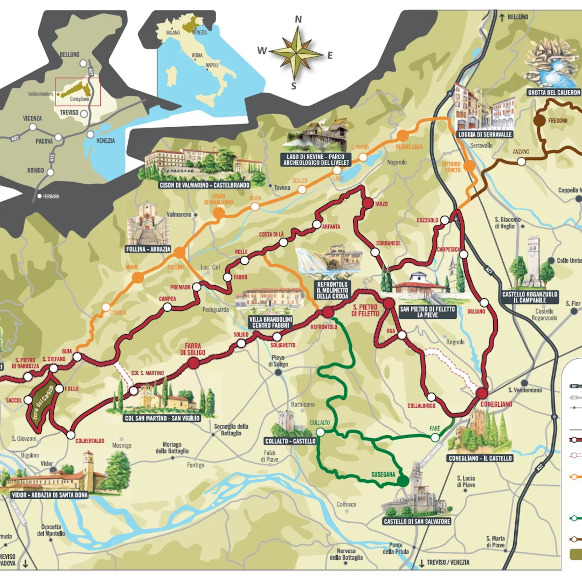
Most visitors to the Prosecco hills follow the same itinerary: a famous name on a sign, a bus, a tasting menu printed in four languages. They leave with a bottle and a photograph—but without ever understanding why this wine is so different from one town to another, from one slope to another. As a certified sommelier who has frequented these hills for years, I want to show you five areas where Prosecco Superiore DOCG tells a different, more intimate story. You won't find them on a search engine. You just have to know who to call.
Some information to help you understand the difference between Prosecco Superiore DOCG and Prosecco DOC
In general, the hours worked in the vineyard on the UNESCO Prosecco Superiore DOCG hills are approximately 4–5 times greater than those required on the flatter lands where Prosecco DOC is produced.
In the hills of Conegliano-Valdobbiadene DOCG and similar areas (a UNESCO World Heritage site), an average of 600–800 hours of work per hectare per year is estimated, often almost exclusively manual due to the steep slopes and the steepness. This is because the vineyards are "heroic viticulture": pruning, mowing, weeding, thinning, and harvesting are almost always done by hand, due to slopes of up to 70–80% and terrain that is difficult to mechanize.
In the flatter DOC lands, vineyard work averages approximately 150–200 hours per hectare per year, with ample opportunity to use machinery for operations such as mowing, weeding, and partial pruning.
Northern slopes
Valdobbiadene, the northern slope: where cold nights build complexity
— Valdobbiadene · Treviso · ~350–450 m above sea level
Terroir: glacial moraine soils, steep slope, marked day/night temperature range
The northern slopes above Valdobbiadene rarely appear in glossy wine magazines. The terrain is too steep for mechanization, the yields too modest for large-scale production. Here, small family-run estates—often no more than a few hectares—are found, where vines cling to terraces rebuilt by hand after each winter.
The cold descends early on these north-facing slopes. The grapes ripen slowly, with a natural acidity that commercial Prosecco producers struggle to replicate. When you taste a glass poured directly from a vat in a cellar carved into the hillside, you immediately understand: this isn't a product. It's a place.
On the palate
Green apple and white peach on a mineral background—wet limestone. The perlage is fine and persistent, with a long, saline finish.
The Grand Cru
Cartizze: the hill that commerce has not yet fully conquered
— San Pietro di Barbozza, Valdobbiadene · 107 hectares total · amphitheater morphology
Terroir: natural amphitheater, sandy-clay soils, reflected heat, late harvest
Cartizze is the most famous and expensive subzone of the entire DOCG—107 hectares whose ownership is so fragmented that most producers own fractions of a single hectare. The amphitheater shape retains heat (it is also known as the Golden Pentagon), prolongs maturation, and produces a wine with a richness that surprises those who consider Prosecco a simple, light aperitif.
What most tourists never experience is the hill itself: walking along the narrow paths between the rows at harvest time, when the fog has lingered in the valley and the vines above it glisten in the autumn light. That moment doesn't exist on a guided bus tour. It requires a private arrangement, a local guide, and the trust of a producer who opens the gates to someone they know.
On the palate
Ripe pear, acacia honey, and a hint of dried flowers. Fuller than any other Prosecco area, with a smoothness that lingers well past the finish.
Southern exposure
Conegliano, the southern hills: sun, clay, and unexpected depth
— Conegliano · Treviso · ~150–250 m above sea level · full southern exposure
Terroir: clay-limestone soils, more hours of sunshine, lower altitude, ripe fruit profile
The hills around Conegliano face south. They receive more direct sunlight than any other part of the DOCG, and the clay soils retain that heat well into the night. The result is a surprising Prosecco: rounder, more generous, with a fruit profile that leans toward yellow plum and ripe apricot rather than the green, crisp notes of higher-altitude vineyards.
Conegliano is the birthplace of the Veneto winemaking school—a fact most winery tours routinely overlook. The producers of this area have generations of technical knowledge behind them. Sitting down with a winemaker in this area means a conversation about the craft, not just a quick tasting.
The Colli di Conegliano isn't just Prosecco! The Colli di Conegliano DOCG also includes excellent, recognized red wines made with local or international grapes well-adapted to the terroir.
On the palate
Yellow peach, ripe apricot, a touch of almond blossom. Rounder and more generous than the northern areas, with less pronounced acidity and an immediate, welcoming warmth.
Inland Valleys
Refrontolo: the hidden valleys where almost no one goes
— Refrontolo · Treviso · Inland Valleys, Mixed Exposure
Terroir: protected valley location, alluvial-clay soils, morning fog, unusual aromatic complexity
Refrontolo is located in the inland folds of the Treviso hills, sheltered from the Adriatic winds that affect the more exposed areas. The morning fog settles there longer, slowing the ripening process and creating a noticeably more complex aromatic profile—floral, herbaceous, with a genuine wildness that's hard to find in commercially distributed Prosecco.
These are the areas where local trattorias still serve Prosecco in unlabeled bottles, filled directly from the producer's vat a few kilometers away. To access the right winery in Refrontolo, you don't need to book online. You go with someone who knows the valley.
Refrontolo is also famous for its Marzemino, an ancient tradition (dating back to the 1400s), and is also famous because Mozart mentions it in Don Giovanni ("Pour the wine! Excellent Marzemino!").
On the palate
Wildflowers, fresh herbs, a hint of elderberry and white currant. Unexpected complexity for a wine with a modest label—or no label at all.
High Altitude
Vittorio Veneto, the high hill: where altitude rewrites the rules
— Vittorio Veneto · Treviso · ~400–550 m above sea level · pre-Alpine transition zone
Terroir: pre-Alpine soils, rocky substrate, extreme temperature ranges, very long growing season
At the northern edge of the DOCG, where the hills begin their slow ascent towards the Dolomites, the story of Prosecco takes on a completely different character. The pre-Alpine rocky substrate forces the vines to descend deep into the soil in search of water and minerals. Harvest here can take place three weeks after that in the valley.
What this produces in the glass is a Prosecco with tension—the kind of wine industry professionals describe as having a "nervous" quality. High acidity, pronounced minerality, a structure that makes you wonder, for a moment, if you're drinking something mountainous. You are. The Dolomites are visible from these vineyards on clear days.
On the palate
Citrus zest, green almond, slate. A wine of edges rather than curves—angular, mineral, demanding. It opens slowly and rewards patience.
These five zones exist. Getting there is another matter.
I am a certified sommelier, cheese taster, and licensed chauffeur, based in Treviso. I've spent years building the relationships that allow my clients to experience the Prosecco hills as the people who live there experience them—not as spectators, but as guests. A private tour with VenetoRoute is not a package. And a conversation that starts before you arrive and continues well after the last glass.